
Independent Contractor vs Employee: Tax, Rights & Contracts Explained | Connor Robertson
Listen on your favorite platform
| Platform | Link |
|---|---|
| YouTube | Listen on YouTube |
| Apple Podcasts | Listen on Apple Podcasts |
| Transistor | Listen on Transistor |
| pod.link | Listen on pod.link |
What Independent Contractor vs Employee: Tax, Rights & Contracts Explained | Connor Robertson Covers
This episode of Agency Uncovered features Connor Robertson explaining the difference between an independent contractor and an employee. He covers the core distinctions: an employee has an employment contract, fixed salary, set hours, and receives instructions on how and when to complete work. Employees also receive benefits like UIF and workers' compensation. An independent contractor works with a company from the outside, sets their own hours, and takes responsibility for their own benefits and tax matters. Connor describes independent contracting as a gateway to owning a small business.
The conversation also explores which arrangement is better. Connor admits he is biased toward independent contracting because of the flexibility and tax deductions for expenses like Wi-Fi, petrol with proper logbooks, printing, and electricity. He notes that being an employee provides more financial security, especially when applying for loans or credit cards. The discussion covers the personality and risk factors involved in choosing between the two paths.
Connor stresses that every arrangement depends on the written contract. He advises listeners to read the contract carefully before signing, especially if they are taking a job with an overseas company or are eager to accept an offer. The episode balances practical tax advice with labor relations insights.
An employee, you work in the company. A contractor, you are essentially an outside body working with the company.Connor Robertson
Guests Featured on Independent Contractor vs Employee: Tax, Rights & Contracts Explained | Connor Robertson
Connor Robertson joins the podcast to explain the legal and financial differences between independent contractors and employees. He is a tax practitioner and labor relations advisor, as shown when he mentions putting on those professional caps during the discussion. Connor also identifies himself as a small business owner and admits he is biased toward independent contracting. His perspective comes from both professional expertise and personal experience running a business.
Key Takeaways From Independent Contractor vs Employee: Tax, Rights & Contracts Explained | Connor Robertson
- An employee works under an employment contract with a fixed salary, set hours, and instructions on how and when to do the job.
- An independent contractor works with a company rather than inside it, sets their own hours, and does not receive employer-provided benefits like UIF or workers' compensation.
- Independent contractors can deduct business-related expenses from taxable income, including Wi-Fi, petrol with proper logbooks, printing, and electricity.
- Banks and lenders view salaried employees as a better credit risk than self-employed independent contractors, which makes loans and credit cards easier to obtain.
- The choice between employee and independent contractor depends on personality and risk tolerance, and reading the contract carefully before signing is essential.
If you are after the flexibility and you are after making your own time, working and making that time worthwhile, I would say being an independent contractor is always better.Connor Robertson
Why Independent Contractor vs Employee: Tax, Rights & Contracts Explained | Connor Robertson Is Worth Your Time
This episode offers a clear and practical comparison of independent contractor and employee status from both tax and labor perspectives. Connor Robertson explains control, hours, benefits, deductions, and financial risk in a conversational way. The discussion is useful for anyone trying to decide between these two work arrangements or trying to understand their current status. The guest's direct examples help clarify common misconceptions, such as being told to work specific hours while still being labeled an independent contractor.
Listeners who are freelancers, small business owners, or people reviewing a job offer will find the episode worth their time. Connor gives honest advice about reading contracts and understanding your own personality before making a choice. He openly shares his bias toward self-employment, but he also acknowledges the security that traditional employment provides. This balanced approach makes the episode valuable without feeling like a sales pitch for one side.
Who Should Listen to Independent Contractor vs Employee: Tax, Rights & Contracts Explained | Connor Robertson
- Freelancers
- Small business owners
- Employees considering contract work
- Tax and labor law beginners
Where to Listen to Agency Uncovered
You can listen to Agency Uncovered on Spotify, YouTube, Apple Podcasts.
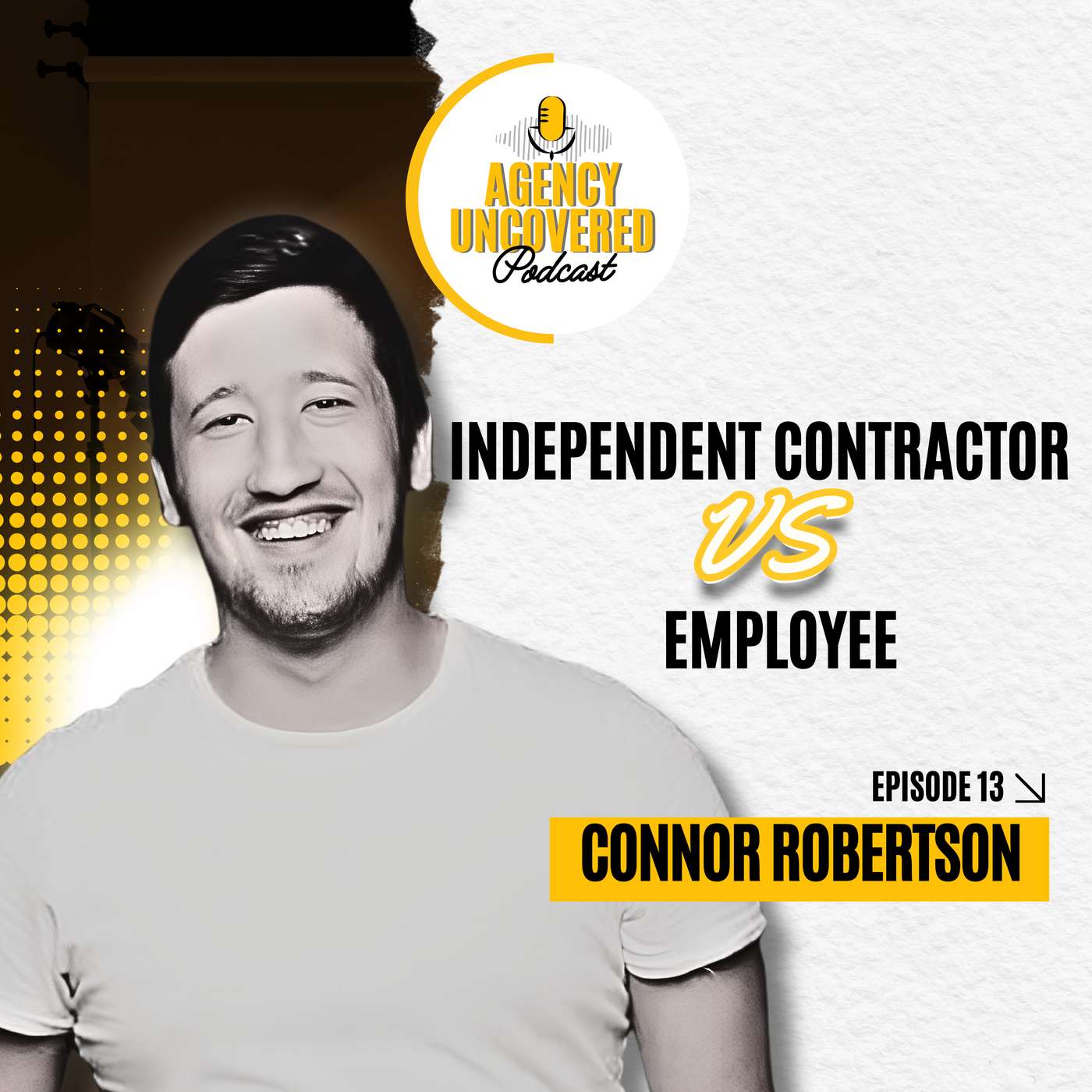
Connor Robertson explains the difference between an independent contractor and an employee, covering tax, UIF, legal rights, and how to tell from your contract which one you really are.
━━━━━━━━━━━━━━━━━━━━
🎙️ IN THIS EPISODE
Connor breaks down what it means to work WITH a company as an independent contractor versus working IN a company as an employee. He explains why being told to work 9 to 5 usually means you aren't a true contractor, and why some South African and offshore companies label employees as contractors to avoid paying employee tax.
He also shares the real pros and cons of independent contracting, from tax deductions like Wi-Fi, petrol and home office expenses to the difficulty of getting loans, car finance and credit when you're self-employed. Plus, how to protect yourself with a strong contract and handle late client payments without damaging the relationship.
Discover why independent contracting can be the gateway to running your own business, and why it suits some personalities better than others.
━━━━━━━━━━━━━━━━━━━━
🔑 KEY TAKEAWAYS
✅ Read your contract: Your contract tells you whether you're an employee or an independent contractor, regardless of what was said in the interview.
✅ Control of your time matters: Employees have their hours and tasks set by the company. Independent contractors set their own hours and agree on deliverables, rates and deadlines.
✅ Contractors carry their own risk: Independent contractors don't get UIF or workers' compensation and aren't protected by the Labour Relations Act or the Basic Conditions of Employment Act.
✅ Tax works differently: Contractors can deduct legitimate business expenses but may find it harder to get loans, vehicle finance and credit.
✅ Let the contract be the bad guy: A professionally drafted contract keeps payment conversations neutral and protects the working relationship.
00:00 Independent Contractor vs Employee: What's the Difference?
03:05 Is It Better to Be an Employee or an Independent Contractor?
04:50 Tax Deductions vs Job Security for the Self-Employed
08:30 How to Tell if You're an Employee or an Independent Contractor
10:50 What Rights Do Independent Contractors Have?
12:00 How to Handle Late Payments From Clients
14:11 Pros and Cons of Being an Independent Contractor
❓ FREQUENTLY ASKED QUESTIONS
▶ What is the difference between an independent contractor and an employee?
An employee works within a company, with set hours, a fixed salary and benefits such as UIF and workers' compensation. An independent contractor works with a company, sets their own hours and is paid an agreed rate for specific services or projects.
▶ Is it better to be an employee or an independent contractor?
It depends on your priorities. Independent contracting offers flexibility, higher earning potential and tax deductions. Employment offers stability, benefits and easier access to credit and finance.
▶ How do I know if I'm an employee or an independent contractor?
Check your contract. Employment contracts usually cover tax deductions, working hours and leave. Contractor agreements usually set out services, rates, deadlines and a fixed project or contract period.
▶ Do independent contractors have the same rights as employees in South Africa?
No. Employees are protected by the Labour Relations Act and the Basic Conditions of Employment Act. Independent contractors work under a civil contract, so their protection depends on what the contract says.
▶ Can independent contractors claim tax deductions?
Yes. Independent contractors may be able to deduct business expenses such as Wi-Fi, travel and home office costs. Speak to a registered tax practitioner, as allowable deductions differ for each person.
━━━━━━━━━━━━━━━━━━━━
👤 ABOUT CONNOR ROBERTSON
Connor Robertson is a tax practitioner, labour relations advisor and small business owner with nine years of experience helping individuals and businesses with tax returns, employment relationships and contracts.
━━━━━━━━━━━━━━━━━━━━
#IndependentContractor #EmployeeVsContractor #SouthAfricaTax #Freelancing #RemoteWork
What is the difference between an independant contractor and an Employee (00:00.289)
Yeah.
What is the difference between an independant contractor and an Employee (00:05.474)
What is the difference between an independent contractor and an employee? We are here with Connor Robertson. So Connor, what's the difference between an independent contractor and an employee? Okay, so an employee obviously there's an employment contract and it well we're both they they both have contracts. And contracts is a very big important theme or or item. I'm going to talk about it a bit more in in like further questions, but
It is essentially somebody who is controlled. You are given a fixed salary. You are given a time within which you are supposed to come into a office, whether you work at an office or from home. And you everything is is generated. It's it's told. You you are instructed on how and when everything should be done. And on top of that, you also have certain securities like your UIF and
You know, your UIF, your workers' compensation and all of that is included in your employment relationship as well. With an independent contractor, you're essentially you work with the company, not in the company. I think that's the best the best way in which to explain it. An employee, you work in the company. A contractor, you are essentially an outside body working with the company.
So you do not have the benefits of UIF or workers' compensation. All of those things are sort of your responsibility or very much your responsibility. And a independent contractor is essentially somebody who would set his own hours. So I feel or I've heard a lot of situations when we do tax returns where a client has said to me he's an independent contractor, but he is told to come into the office from
nine until five that isn't necessarily an independent contractor. You're your hours are still determined. An independent contractor essentially you are telling the client I am giving you 20 hours a week or I'm giving you 20 hours a month in which from my own time I will give you in exchange for an hourly rate or a monthly rate we agree on. With an employment you're essentially given a stipend and
What is the difference between an independant contractor and an Employee (02:27.946)
you you don't have a hell of a lot of leverage or or negotiation around there. You can sort of in your interview process you will tell the person what's your expectation. But usually when there's an offer and you're in need of that employment, you genuinely tend to take it. So independent contractor is sort of the gateway to starting your own business in a sense where like you say
There are certain things that are your responsibility. And if you were an employee, the company would naturally see to those other aspects of your job for you. Would you be able to elaborate as to is it better to be an employee or an independent contractor? Okay. So first of all, I'm very biased because I am myself a I wouldn't call it an entrepreneur, but I'm a small business owner. So I would say
If you are after the flexibility and you are after making your own time, working and making that time worthwhile, I would say being an independent contractor is always better. I would almost say, like you said, an independent contractor is the gateway drug to entrepreneurship and owning your own small business. so in my in my humble opinion, I would say that.
Being an independent contractor is a hundred times better. If I look at it from a perspective of if you work from home, you have a Wi-Fi as a deduction. For if you're if you're speaking about tax, you have Wi-Fi as a deduction. If I am going to visit a client and I fill in my logbooks correctly, I have petrol now I deduct from my taxable income.
And then you've got so many others. You've got you've literally got your printing, your electricity, not everything. Obviously speak to a tax practitioner to discuss what those at home expenses would be because they are different for every independent contractor slash small businesses. But the means at which you can I always say play around with your taxable income.
What is the difference between an independant contractor and an Employee (04:49.578)
I always say you do not get these advantages being employed to somebody else. But being employed has its own form of security. Because at the end of the day, if you are going to a bank, if you're going to go buy a car, you do tend to be a better, they call it a better risk. You have a better risk portfolio when it comes to employment. So I have to mention both when when I talk about pros and cons.
Because it is a bit more it is a bit more difficult to get a loan or a vehicle or a credit card being self-employed. Because being an independent contractor means you are self-employed. If I look at the job as a whole, everything is your fault. Everything is your fault. Whether you look at the job itself, everything is your fault.
In employment, there's a hierarchy, your manager takes the fall and then he sort of disciplines down where you've at least got protection in that regard. I find as soon as I became self employed, everything was my fault. So if you've got the the I would say that it's not a drive thing. It's a personality thing. If you've got that personality where
You want to learn new things, you want to really get in there and you also want to make the most out of your time, which is now your money. Independent contracting is is the way to go. But if you are looking for that security and that security is the thing that makes you comfortable, I would say becoming a employee, there is absolutely nothing wrong with it. I just think there's definitely a personality thing to it and you've got to just like investing.
You've got to be able to know what your level of risk you wanna take and you've gotta go in wholeheartedly. I don't think if you're going to be an independent contractor, I don't think you want to like dabble a bit in the in the shallows and then see if you can swim. It's more dive in and then sort of figure out how you're gonna swim sort of thing. Like you say, when you're an independent contractor, you
What is the difference between an independant contractor and an Employee (07:09.526)
And it's very similar to owning your own business. You're solely responsible for how much money comes in every month. when things change you and need to be on your feet and willing to pivot and understand the risks but still move forward. Which as an employee, you take that for granted where, you know, whatever happens at the month, you still get the same salary and you and you fine. Same with the independent contractor, but the thing is it's the risk is still there of
things not being as consistent. I definitely think you've got you're onto a point there because if I think about it as an as an independent contractor, remember you you're a slave to your own contract. So if if you're not stern enough, I mean the first can come along, the seventh can come along, the fifteenth can come along, and if your contract isn't stern enough and you're you're sort of I I feel like when you become a
a independent contractor, you f you first try and make friends with your client where I I definitely feel like it's a similar thing to when you're working with colleagues. You're trying to become everyone's friends so that you can try and get everyone to to get on board. But when it comes to payment, you've got that you definitely have that risk. And once that risk hits you, I I'm not sure about you, but if I had to tell my my landlord I'm still waiting for a payment, they don't care.
But if I think of someone maybe starting out and then they say they apply for a job, maybe it's for an overseas company, they don't really read too much of the fine print because they need the job, so they once they get the offer, they sign on. For someone in that position, how can they tell whether they're an employee or an independent contractor? Okay. So my first piece of advice, whether I put on my tax practitioner cap or I put on my labour relations cap.
Labor relations advisor cap, you have to read your contract because your contract's gonna tell you exactly what you are. Yeah, an employee will always speak about tax and deductions and times you have to come into work and essentially hybrid, non hybrid. A independent contractor is this is the services that you're gonna be providing at this rate. This is when we
What is the difference between an independant contractor and an Employee (09:35.862)
you know, we want these deadlines because it's usually project based. A lot of the times you're dealing with somebody who either nobody's going to to give you a service level agreement that doesn't have like a time period. Usually it's a year or so on, or it's project based. I find a lot of the times you're dealing with s with a client who comes to you and they they want your assistance for a specific project. And essentially they they'll let you know
They need these services like web development, whatever. They need these services for this period of time or for this specific client of theirs or project of theirs. So I think your contract's always going to tell you what you are. And and don't be fooled by the the meeting, because often I cannot tell you whether it is South African businesses or offshore businesses, oftentimes
People are trying to employ other people, they just do not want the hassle of paying their tax. So you've really just got to look at your contract. What rights do independent contractors have compared with employees? I think you touched on it a little bit earlier. Yeah. So if if I'm gonna be very honest with you, independent contractors don't have I'm going to say this and it's gonna sound nasty.
But they don't have rights in the same way that an employee would have rights because employees are essentially protected by the Labor Relations Act, the Basic Conditions of Employment Act. But because it's a civil contract between a client and a service provider or independent contract, you are essentially, it sounds once again terrible, but you're a slave to the contract that you set up between you and your client. So
I think in order to protect yourself, that contract needs to be so ironclad because if it's not and you're essentially getting a contract from the client and you're just signing at the dotted line, you are essentially going to be a slave to it, whether it's a good contract for you or it's a bad contract. This is very important when it comes to payment because like I said to you earlier, the first can come along, the fifth can come along the seventh, the fifteenth, and next month can come along.
What is the difference between an independant contractor and an Employee (11:57.326)
But if you're not stern on your how you want to be paid, remember a client is going to read your contract. You should do the same. And remember, I th I always encourage any of my clients to say a contract makes everything neutral. It doesn't make it personal. It doesn't make it it doesn't make it like an issue. It's just a contract that we both agreed on.
So when it comes to payment, because payment's the big, the big be all end all, right? So when it comes to payment, it's like, but we we said on our contract that payment is 30 days, payment is 15 days. So I really need you. It's not my fault, right? Remember you've w people work with people. So the biggest way to
to continue that relationship without it being about money because money is always going to be an issue and it's always an a thing that destroys the working relationship. In order for that to for you to uphold your relationship or your working relationship with your client, you need to make a bad guy. But I would rather make a non tangible item the bad guy than you yourself the bad guy.
So it's like, listen, unfortunately, I don't set up my contracts. I've got a lawyer who set up the contract. This is just to look after our interests. I hope you understand. Instead of going, yes, the contract states. Because now you're the you're the villain in the situation. So I think it's so important for you to have these contracts set up by a professional. And when you bring up the c contract, just go, listen, I don't set up these contracts.
I paid a lawyer to do it. He's looking out for my interests. I hope you understand. Because then the lawyer's the bad guy, not you. And then your working relationship is saved. Yeah. It is a it can be a bit of an awkward conversation, but that transparency is what is key for a long lasting healthy relationship because there's so much that does pop up between a client and a service provider. You did also touch on this a little bit earlier, but what are the
What is the difference between an independant contractor and an Employee (14:11.224)
biggest pros and cons of working as an independent contractor? No. Okay. So the con is once again, everything is your fault. Whether things go right or things go wrong, everything is your fault. you don't have a a 15-day, you know, leave you can take with you and your family. especially the first three years, I would say, is where you're really grinding. So your hours could be anything from eight
two five if you're lucky. Or it could really be eight until nine, which was my case until until I met my beautiful wife. And and obviously business grew and you know the things those things do take place. But often you are essentially you're your HR. You are the the owner. You are the project manager. You are you're the administrator. You have so many hats it's it's a bit crazy.
And that is both a a pro and a con because you're essentially just learning business on so many levels that I think if you ever had to go back to to the workplace, which I honestly couldn't right now, I'll be very honest. I've been doing this for nine years and I honestly couldn't go back. But if you had to go back, you would have such a greater understanding of what your manager
the director is going through, but essentially everything is your fault. And then if I look at and and that I would say is like your biggest con, but your biggest pro is essentially if you have a salary, if you look at what you would be paid as a salary compared to if you had to break down an an actual effective professional hourly rate, the two on
The two you can never compare because one hundred percent if it's your time, you're definitely getting paid more. The problem comes in that you have to go get your clients. You have to make sure you keep your clients. And then on top of that, you essentially have to continue to build your brand. Because as somebody who's been doing my company for nine years, my brand is something that's that's some it's that's something that I had to grow.
What is the difference between an independant contractor and an Employee (16:36.458)
over time. And that comes in with the negative reviews. That comes in with the positive reviews. And honestly, you're you're you're it's more like boxing to be fair, because sometimes you're just weaving and and playing defense. And often you're when you're hot, you're really hot. And when you're not, you're really not. Right. No, that's a fantastic analogy. And Connor, thank you so much for your insights on this topic. We really appreciate you giving your time. Thanks so much.