How Do You Hire the Right Person for Your Business?
Listen on your favorite platform
| Platform | Link |
|---|---|
| YouTube | Listen on YouTube |
| Apple Podcasts | Listen on Apple Podcasts |
| Transistor | Listen on Transistor |
| pod.link | Listen on pod.link |
What How Do You Hire the Right Person for Your Business? Covers
This episode covers the process of hiring the right person for a business. Alexa Booth da Silveira discusses the importance of defining the role, required skills, and cultural fit before interviewing candidates. She emphasizes structured interviews that test real-world problems to assess both technical ability and alignment with company values. The conversation moves to job descriptions, where Alexa advises against wish lists and recommends action lists with focused requirements. She highlights common interview mistakes such as talking too much, asking generic questions, and ignoring red flags in attitude. Alexa also explains how to distinguish a polished CV from a genuinely good hire by using paid skills tests and checking references for consistent answers. The episode concludes with a discussion on experience versus attitude. Alexa notes that experience can be outdated, and that attitude, curiosity, and resilience are better predictors of long-term success. Skills can be taught, so hiring for mindset over track record can be more effective.
Attitude, curiosity and resilience often predict long-term success better than experience does.Alexa Booth da Silveira
Guests Featured on How Do You Hire the Right Person for Your Business?
Alexa Booth da Silveira is the featured guest on this episode. She shares her insights on hiring based on her professional experience in evaluating candidates and advising employers. Her advice covers the full hiring process, from defining roles to conducting interviews and making final decisions. Throughout the conversation, Alexa provides practical examples and warns against common pitfalls. She stresses the importance of objective assessments and reference checks to verify candidate claims.
Key Takeaways From How Do You Hire the Right Person for Your Business?
- Define the role, required skills, and cultural fit before beginning the hiring process.
- Use structured interviews that test real-world problems to assess candidates effectively.
- Write concise, outcomes-focused job descriptions with an action list rather than a wish list.
- Avoid common interview mistakes like talking too much, asking generic questions, and ignoring attitude red flags.
- Prioritize attitude, curiosity, and resilience over experience because skills can be taught.
Attitude, curiosity and resilience often predict long-term success better than experience does.Alexa Booth da Silveira
Why How Do You Hire the Right Person for Your Business? Is Worth Your Time
This episode is worth listening to for anyone involved in hiring. Alexa Booth da Silveira offers clear, actionable advice that cuts through common hiring myths. Her focus on structured interviews and skills tests provides a practical framework for improving the selection process. Business owners and hiring managers will find value in the discussion on job descriptions and experience versus attitude. The conversation is direct and grounded in real-world hiring challenges, making it a useful resource for improving recruitment outcomes.
Who Should Listen to How Do You Hire the Right Person for Your Business?
- Small business owners
- Hiring managers
- Recruiters
- Startup founders
Where to Listen to Agency Uncovered
You can listen to Agency Uncovered on Spotify, YouTube, Apple Podcasts.
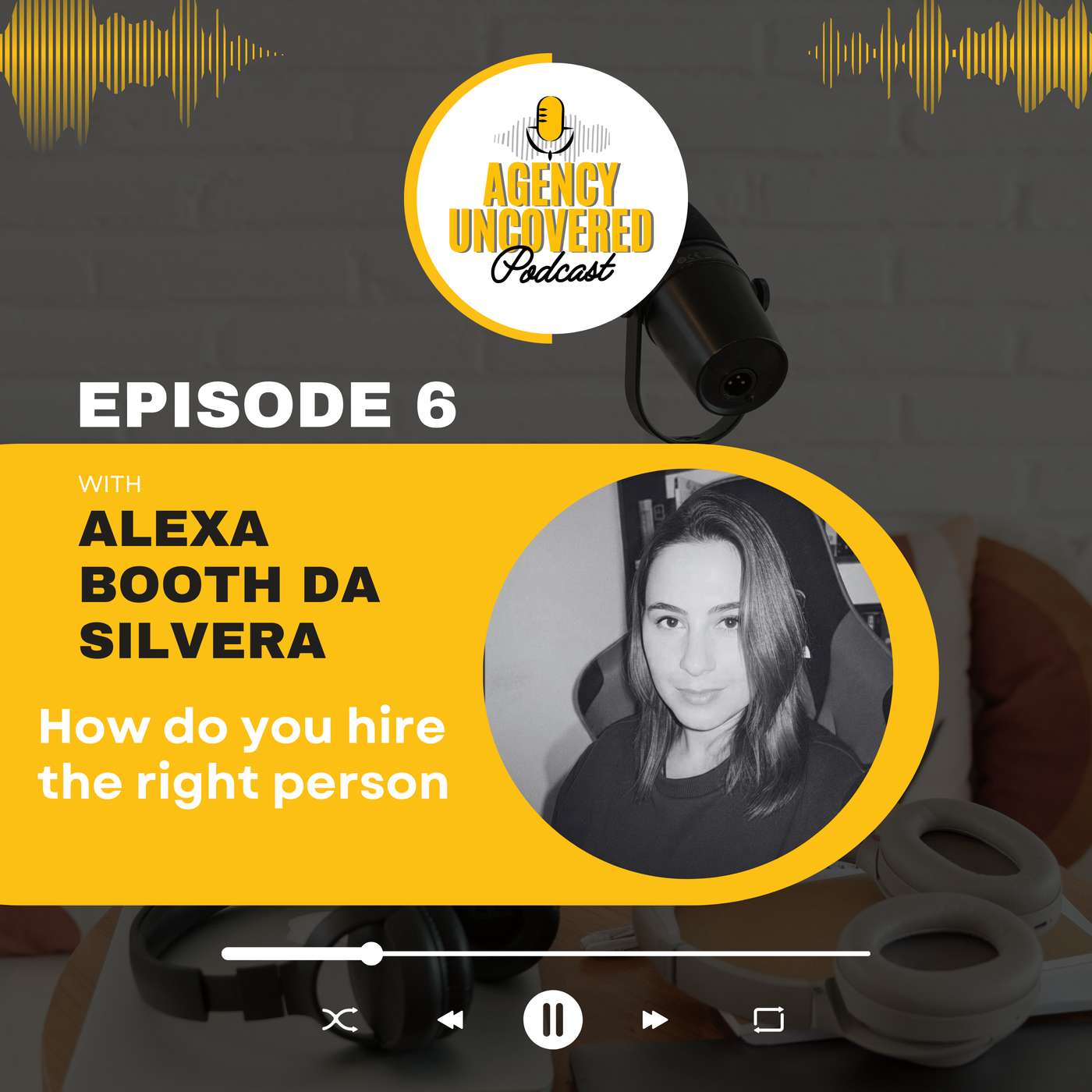
Recruitment expert Alexa Booth da Silveira breaks down how to define the right hire, write job descriptions that attract them, and spot a genuinely good candidate.
Recruitment specialist Alexa Booth da Silveira walks through a practical hiring framework: define the role and required competencies before you post it, write outcomes-focused job descriptions instead of wish lists, and use structured interviews and paid skills tests to separate a great CV from a genuinely great hire. She also tackles the experience-versus-attitude debate, arguing that curiosity and resilience often predict long-term success better than years on a resume.
Key Takeaways
- Define the role before you search for the person. Get specific on required skills, culture fit, and measurable outcomes first — structured interviews built around real-world problems reveal whether someone is actually right for the role.
- Write an action list, not a wish list. Job descriptions should be concise, outcomes-focused, and highlight growth opportunities rather than piling on every possible requirement.
- Don't ignore attitude red flags in interviews. Interviewers often excuse poor attitude as nerves — but attitude issues rarely disappear once someone is hired.
- Test skills, don't just read them on a CV. A paid skills test tied to a real problem the role requires, plus reference checks, reveals whether claimed results hold up.
- Attitude and curiosity can outweigh raw experience. Skills can be taught if someone has the right mindset — resilience and curiosity often predict long-term performance better than years of experience.
Frequently Asked Questions
What's the first step to hiring the right person?
Define the role clearly first — required skills, culture fit, and measurable outcomes — before writing the job post or interviewing anyone.
How should employers write job descriptions?
Keep them concise and outcomes-focused, like an action list rather than a wish list, and highlight real growth opportunities.
What's the biggest mistake employers make when interviewing?
Talking too much and asking generic questions that don't probe for real examples of impact, while excusing attitude red flags as nerves.
How do you tell a strong CV from a genuinely strong hire?
Use a paid skills test tied to a real problem the role requires, then check references and compare consistency against what's claimed on the CV.
Does experience matter more than attitude when hiring?
Not necessarily — attitude, curiosity and resilience often predict long-term success better than experience alone, since skills can be taught.
About the Guest
Alexa Booth da Silveira is a recruitment specialist who helps businesses build effective, structured hiring processes — from defining roles and writing job descriptions to screening for skills and culture fit.
#Hiring #Recruitment #JobDescriptions #CandidateScreening #HiringProcess
Sasha Damon (00:01)
How do you hire the right person for your business? We’re here with Alexa Booth da Silveira. So Alexa, tell us — how do you hire the right person for your business?
Alexa Booth da Silveira (00:11)
The first step in finding the right person for your business is actually defining what you’re looking for. Define the role, define the skills. You need to be able to assess the technical skills but also the culture fit. What are you looking to bring into your company? And make sure you use structured interviews that test real-world problems. Those answers will tell you whether they’re the right person for your business or not.
Sasha Damon (00:41)
And what should employers look for when defining the right candidate for the role?
Alexa Booth da Silveira (00:48)
This is based on the key competencies. What are you looking for? What are they going to be responsible for? How are you going to measure the outcomes — what measurable outcomes do you have? How adaptable are they to change, and can they carry on with what needs to be done? And do they align with your company values?
Sasha Damon (01:12)
That’s very interesting. And how can businesses write job descriptions that attract the right candidate?
Alexa Booth da Silveira (01:20)
First of all, don’t have a wish list — have an action list. Have focused requirements. Keep the job description concise and outcomes-focused, and highlight growth opportunities. Avoid filling space in the job description; rather keep it straight to the point.
Sasha Damon (01:39)
What are the biggest mistakes employers make when interviewing candidates, in your experience?
Alexa Booth da Silveira (01:46)
In my experience, sometimes employers talk too much. They go on about different topics, and they ask generic or random questions that don’t actually pertain to the role. They never really probe for examples of the impact or the value the candidate delivered.
Sometimes they ignore the red flags in someone’s attitude during the interview and write it off as nerves, or as not being prepared enough. But you can’t fake a good attitude.
Sasha Damon (02:19)
That’s true. So how can employers tell the difference between a good CV and a genuinely good hire? Because someone can go onto Canva and make a beautiful CV that immediately catches your eye, but the experience isn’t quite there.
Alexa Booth da Silveira (02:35)
Look, in today’s age of AI you can build a tailor-made CV for every application you send. But telling the difference comes down to doing a skills test — a paid skills test. Give them an actual problem to solve that the role requires.
Then check references, and evaluate how consistently they answer compared to what they say on their CV. So if they say they built a sales pipeline and it delivered 300% revenue growth — how are they going to solve that problem for you? Look for those consistent answers.
Sasha Damon (03:14)
When hiring a candidate, sometimes you think experience equals good performance and the ability to solve all those problems for you. But others argue for hiring someone with a bit less experience who knows the landscape, because you get to mould them to fit the role better. So would you say hiring based on experience is overrated, when attitude and potential might matter more?
Alexa Booth da Silveira (03:44)
That’s a bit of a yes-and-no answer. Experience alone can be outdated when hiring. Attitude, curiosity and resilience often predict long-term success better than experience does. Skills can be taught — you can teach anyone to do anything if they have the right attitude.
Sasha Damon (04:05)
Well Alexa, thank you so much for sitting down with us. We really appreciate it.
Alexa Booth da Silveira (04:10)
Thank you.